
 By Amelia James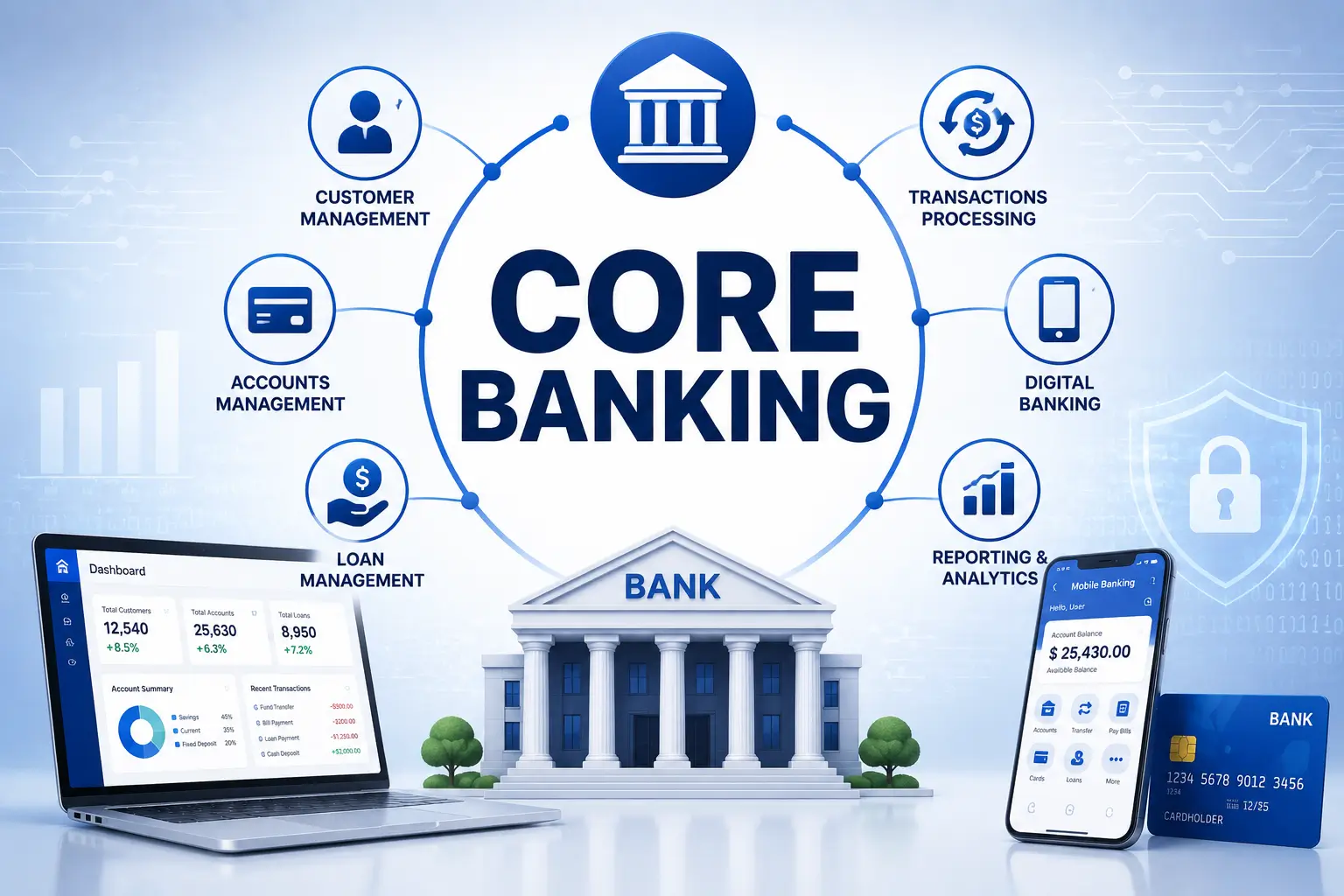
Have you ever wondered how a bank lets you deposit money in one branch and withdraw it from another in seconds? Or how your balance updates the moment you make a payment? The answer is core banking.
It is the technology working quietly behind every bank. Most customers never see it, but they use it every single day. In this guide, we explain what it is, how it works, its main features, and why it matters so much in 2026.
We keep everything simple and easy to follow. No confusing technical language. Just clear explanations you can actually understand.
At techeadvice.co.uk, we cover banking and financial technology topics regularly for our US readers. Our goal is always to break down complex systems into simple, useful information.
Core banking is the central system that banks use to run their daily operations. It manages accounts, deposits, withdrawals, loans, and transactions, all from one connected system.
Think of it as the engine inside a car. You never see the engine while driving, but without it, nothing moves. It works the same way inside a bank.
In simple words, core banking means the software that connects all bank branches, ATMs, mobile apps, and online banking together. It allows a customer to bank from anywhere, not just one specific branch.
Before it existed, each branch worked almost like its own separate mini bank. Records were stored locally. If you wanted to access your account somewhere else, it took time and paperwork.
It removed that problem completely. Now, everything is centralized and updated instantly.
This shift changed banking forever. Customers gained the freedom to manage their money from anywhere, without worrying about which specific branch originally opened their account. For banks, it meant better control over data, fewer errors, and a much clearer picture of every customer relationship across the entire organization.
It works through a centralized system that connects to every banking channel. This includes physical branches, ATMs, mobile apps, and online banking portals.
Here is a simple example. When you withdraw cash from an ATM, the ATM sends a request to the IT system. The system checks your balance, approves the transaction, and updates your account instantly. All of this happens in just a few seconds.
This centralized structure is often called a “core,” which stands for centralized online real-time environment. That name really explains its main job. Everything runs from one central place, online, and in real time.
Because of this setup, banks can offer consistent service no matter which branch or app a customer uses. Your account information stays exactly the same everywhere.
This is also why banking today feels so seamless compared to a few decades ago. Back then, moving money between branches or cities could take days. Now, that same process happens in seconds because every part of the bank is connected to the same central system. The core banking platform acts like a shared brain that every branch, app, and service checks before completing any action.
Behind the scenes, the system also runs constant checks. It verifies account status, confirms available balance, and applies any necessary fees or interest calculations automatically. All of this happens without the customer ever noticing the complexity involved.
It systems come packed with features that keep daily banking smooth and reliable. Let’s look at the most important ones.
Each feature plays a specific role in making banking faster, safer, and more convenient. Together, they form the foundation that supports everything from a simple balance check to a large business loan.
Every customer’s information is stored in one central place. This includes account details, transaction history, and personal information.
This means any branch or channel can access accurate, updated information instantly. There is no need to transfer paper records or wait for updates between branches.
This centralization also makes customer service faster. If you call your bank with a question, the representative can pull up your full account history immediately, no matter which branch you originally used. This saves time for both the customer and the bank staff handling the request.
Modern core bank systems process transactions immediately. Deposits, withdrawals, and transfers reflect in your balance right away, not after hours or a full day.
This real-time processing is one of the biggest reasons digital banking feels so fast today. Customers expect instant results, and it makes that possible.
Real-time processing also supports better fraud detection. Since transactions are recorded the moment they happen, unusual activity can be flagged and reviewed almost immediately, rather than being discovered hours or days later. This quick response helps protect both the bank and the customer from financial losses.
With it, customers are not tied to one specific branch. You can walk into any branch, use any ATM, or open the mobile app, and your account works the exact same way everywhere.
This flexibility has become a basic expectation for modern banking customers. Nobody wants to be limited to just one location anymore.
This feature also supports customers who travel or relocate often. Whether you move to a new city or simply visit a different branch while traveling, your account works exactly the same way. There is no need to notify your bank in advance or transfer your account records manually.
It systems also manage loans and deposits automatically.
This includes:
- Calculating interest on savings and loans.
- Tracking repayment schedules.
- Applying fees and charges correctly.
- Updating balances without manual entry.
Automation reduces human error significantly. It also speeds up processes that used to take days into something that happens in minutes.
For example, loan approvals that once required extensive manual paperwork can now move through automated checks much faster. This does not remove the need for proper review, but it does remove repetitive manual steps that used to slow everything down.
It creates value on both sides, for the bank running the system and for the customer using the services. Let’s break down the biggest benefits.
These benefits are not just theoretical. They show up in real, everyday moments, like transferring rent money instantly or checking your balance while standing in line at a store.
Customers no longer wait in long lines for simple tasks. Transfers, balance checks, and payments happen almost instantly. This speed has become one of the top reasons people choose one bank over another.
In today’s world, patience for slow financial services has almost disappeared. Customers compare their banking experience to other fast digital services they use daily, like shopping apps or food delivery. It helps banks keep up with these rising expectations.
When banking feels smooth and fast, customers feel more confident and satisfied. It supports features like mobile banking, real-time alerts, and easy account access, all of which improve the overall experience.
A better experience also means fewer customer complaints and higher trust in the bank.
For banks, automation through IT reduces the need for manual processes. Fewer manual tasks means fewer errors and less staff time spent on repetitive work.
This efficiency allows banks to focus more resources on improving services rather than fixing mistakes.
Lower operational strain also means banks can invest more in customer-facing improvements, like better mobile apps or faster support systems. Instead of spending time and effort on repetitive back-office tasks, staff can focus on solving real customer problems and improving overall service quality.
Not every bank uses the same type of IT setup. There are generally two main types.
Understanding the difference between these two approaches helps explain why some banks feel more traditional in how they operate, while others feel more modern and flexible in the services they offer.
This is the traditional approach. The bank owns and manages its own servers and infrastructure. It gives the bank full control, but it also requires more maintenance and internal technical staff.
Many older, established banks still use on-premise systems, especially larger institutions with long operating histories.
Maintaining an on-premise system requires ongoing investment in hardware, technical staff, and regular updates. While this gives banks complete control over their data and infrastructure, it can also slow down how quickly new features or improvements get rolled out to customers.
Cloud-based, it is hosted and managed by a third-party provider. The bank does not need to maintain physical servers itself.
This approach has become extremely popular in recent years. It offers more flexibility, easier scaling, and often faster updates compared to older systems.
Many new digital banks and fintech companies use cloud-based IT from day one, since it allows them to launch quickly without building physical infrastructure.
Cloud systems also make it easier to add new features over time. Instead of waiting for a major system overhaul, banks can update or expand their services gradually. This flexibility has made cloud-based IT especially attractive to smaller banks and credit unions that want modern capabilities without a massive upfront investment in physical technology.
Older, traditional banking systems generally worked in batches. This means transactions were often processed at the end of the day rather than instantly.
It changed this completely. Modern systems work in real time, meaning updates happen the moment a transaction occurs.
Here is a simple comparison:
- Traditional systems: slower processing, limited to single-branch records, and manual updates.
- Its systems: real-time processing, centralized data, automated updates across all channels.
This shift has made banking faster, more accurate, and far more convenient for everyday customers.
It is worth remembering that many banks today still operate a mix of both systems during their transition period. Moving an entire bank to a fully modern core system takes time, careful planning, and testing. Because of this, some parts of a bank’s operations may still rely on older processes while newer, faster systems gradually take over.
If a bank is choosing or upgrading its core banking system, certain features matter more than others.
Here are the most important ones to look for:
- Real-time processing for instant transaction updates.
- Open API support to connect with other digital tools and fintech apps.
- Strong security and fraud protection tools.
- Support for mobile and online banking channels.
- Automated compliance and reporting tools.
- Scalability to handle growing customer numbers.
These features help ensure the system stays useful and competitive for years, not just at launch.
Choosing the right system is a long-term decision. A bank that picks a system without room to grow may find itself struggling again in just a few years as customer needs change. This is why forward-thinking banks prioritize flexibility and scalability just as much as current functionality when evaluating new core banking platforms.
Upgrading or implementing a new IT system is not always simple. Banks often face a few common challenges along the way.
These challenges are important to understand, especially for smaller institutions with limited technical teams. Knowing what to expect ahead of time helps banks prepare properly and avoid unnecessary setbacks during the transition process.
- Data migration risks: Moving years of customer data to a new system can be complex and requires careful planning.
- Staff training: Employees need proper training to use new systems effectively.
- Integration issues: Connecting the new core system with existing tools and apps can take time.
- Regulatory requirements: Banks must ensure the new system still meets all compliance rules during and after the transition.
- Downtime concerns: Any system change carries a small risk of temporary service interruptions.
Despite these challenges, most banks find that the long-term benefits of a modern IT system outweigh the short-term difficulties of implementation.
Proper planning makes a huge difference here. Banks that take a gradual, step by step approach to upgrading their systems generally experience fewer disruptions than those attempting to change everything at once. Testing each part of the new system carefully before full rollout also helps avoid unexpected issues once customers start using it.
Security is one of the biggest priorities in IT, especially for banks operating in the United States. Since these systems hold sensitive financial data, strong protection is absolutely necessary.
Common security measures include:
- Data encryption to protect information during transmission and storage.
- Two-factor authentication for customer logins.
- Continuous fraud monitoring and transaction alerts.
- Regular security audits and compliance checks.
- Strict access controls for internal bank staff.
US banks also follow strict regulatory guidelines to protect customer data and maintain trust. These regulations require banks to regularly update their systems and report any suspicious activity quickly.
For customers, this means their financial information is protected by multiple layers of security, not just a single password.
Banks also invest heavily in staff training around security practices. Even the strongest technology can be undermined by human error, so employees are regularly trained to recognize suspicious activity and follow strict data handling procedures. This combination of technology and trained personnel creates a much stronger overall security system.
It is not just for large national banks. It supports a wide range of financial institutions today.
This includes:
- Traditional retail and commercial banks.
- Credit unions serve local communities.
- Digital-only banks and neobanks.
- Fintech companies offering banking-like services.
Basically, any organization that manages customer accounts, deposits, or transactions relies on some form of core banking technology to operate smoothly.
Even smaller community banks and credit unions, which once relied heavily on manual processes, now use IT systems to stay competitive. As customer expectations continue to rise, having a reliable core system is no longer optional for any financial institution, regardless of its size.
It may run quietly in the background, but it plays a massive role in how modern banking works. From instant transfers to secure account access, almost every banking convenience customers enjoy today depends on this technology.
As more banks move toward cloud-based systems and real-time processing, core banking will only continue to improve. Faster services, stronger security, and smoother digital experiences are all part of this ongoing shift.
For clearer, easier-to-understand technology guides like this one, you can always explore techeadvice. We break down complex topics into simple, practical information that US readers can actually use.
Understanding it helps you appreciate just how much technology works behind the scenes every time you check your balance or send a payment. It is one of the most important, yet least talked about, parts of modern financial life.
Whether you are a curious customer or someone working in the financial technology space, knowing how it functions gives you a clearer picture of the entire banking system. The next time your transfer completes in seconds, you will know exactly what is happening behind that simple confirmation message.
It is the central software banks use to manage accounts, transactions, and daily banking operations in real time.
No. Online banking is a customer-facing app, while core banking is the system working behind it.
Cloud systems offer more flexibility, faster updates, and easier scaling compared to older on-premise setups.
Yes, it uses encryption, authentication, and continuous monitoring to protect customer data.
It varies by bank size, but most upgrades take several months due to careful data migration and testing.