
 By Amelia James
Most people have used dozens of apps without ever thinking about what went into building them. But if you’re a business owner, entrepreneur, or someone exploring tech options, that question matters a lot, especially when off-the-shelf solutions just aren’t cutting it.
Custom mobile development is the process of designing and building a mobile application specifically for your business, your users, and your goals. Nothing is pre-packaged. Everything is built from the ground up to fit exactly what you need.
This guide will walk you through what it really means, how it works, what it costs, and when it actually makes sense to go this route.
Custom mobile development means building a mobile app tailored specifically to your needs, rather than using a generic, ready-made solution. It gives you full control over features, design, and performance, but it takes more time and investment than off-the-shelf alternatives.
Custom mobile development is the end-to-end process of creating a mobile application that is built specifically for one organisation or purpose. It covers everything from planning and UI/UX design to coding, testing, and launching the app on iOS, Android, or both. Unlike template-based platforms, every feature is purpose-built.
The mobile app market is enormous. Millions of apps exist across the App Store and Google Play. But here’s the thing: most businesses that rely on generic, ready-made app platforms eventually hit a wall.
The platform doesn’t support a feature they need. The design can’t match their brand. Or the app slows down as its user base grows. That’s when custom mobile app development becomes a serious conversation.
According to Statista, mobile apps are projected to generate over $935 billion in revenue by 2023, and that number keeps climbing. Businesses that invest in well-built, purpose-designed apps tend to see stronger user engagement and retention than those using cookie-cutter alternatives.
Building a custom app isn’t a single event; it’s a structured process. Here’s how it typically unfolds:
1. Discovery and Planning This is where goals get defined. What problem does the app solve? Who are the users? What features are essential vs. nice-to-have? A good development team will spend real time here before writing a single line of code.
2. UI/UX Design The user interface (how it looks) and user experience (how it feels to use) are designed at this stage. Wireframes and prototypes are built so you can see the app before it’s coded.
3. Development This is the actual coding phase. Developers build the app using languages and frameworks suited to your platform: Swift or Kotlin for native apps, or React Native and Flutter for cross-platform builds.
4. Testing and Quality Assurance Before launch, the app goes through thorough testing, checking performance, security, usability, and compatibility across different devices.
5. Deployment The app is submitted to the App Store, or Google Play (or both), and the team handles the technical requirements for approval.
6. Maintenance and Updates: Custom development doesn’t end at launch. Ongoing updates, bug fixes, and feature additions are part of the long-term picture.
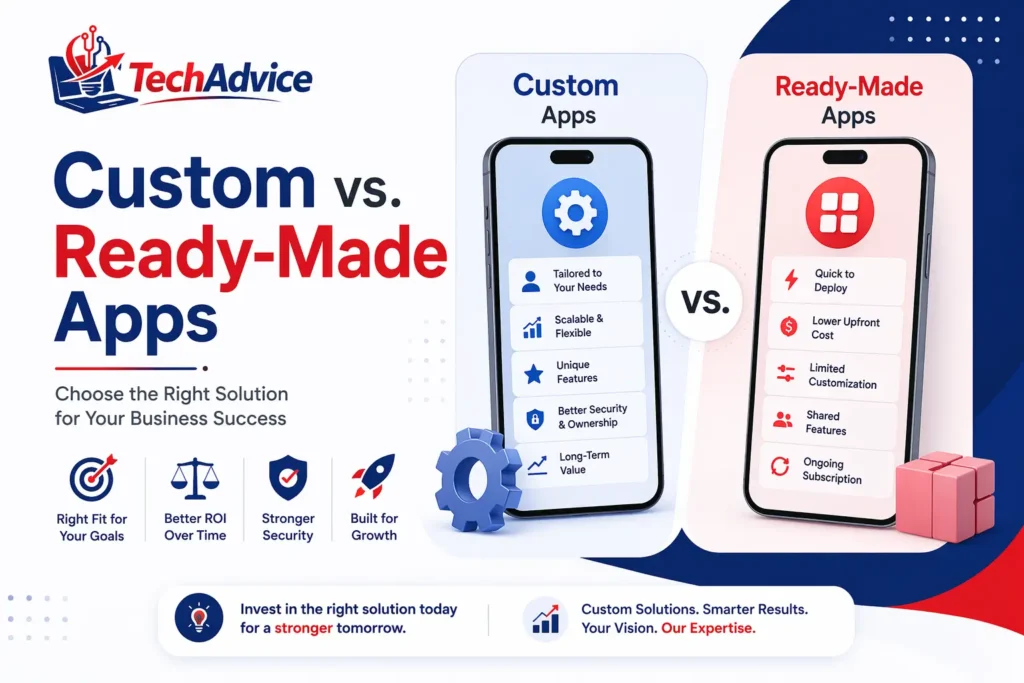
This is the question most people are really asking. Here’s a clear breakdown:
| Factor | Custom Mobile Development | Ready-Made App Platform |
| Flexibility | Fully flexible | Limited to platform features |
| Cost | Higher upfront | Lower upfront, ongoing fees |
| Timeline | Longer (weeks to months) | Faster setup |
| Ownership | You own the code | The platform controls it |
| Scalability | Built to scale with you | Can hit limits as you grow |
| Branding | 100% your brand | Often templated |
Neither option is universally better. The right choice depends entirely on your business stage, budget, and how unique your requirements are.
Not every business needs a fully custom app. But there are clear situations where it makes sense:
You have unique workflows. If your business operates in a way that no existing app supports, think specialised inventory systems, niche service bookings, or complex multi-user platforms, custom development is often the only real path.
You’re building for scale. A startup in San Francisco recently needed an app that could handle real-time location tracking, custom push notifications, and a loyalty rewards system all in one place. No off-the-shelf tool handled all three cleanly. A custom-built solution solved it in one cohesive app.
You want full data control. With a custom app, your user data stays under your control. You choose where it’s stored and how it’s protected. With third-party platforms, you’re often bound by their data policies.
Your brand experience matters. Custom apps let you design every pixel, every animation, every interaction exactly how you want them. That level of brand consistency isn’t possible with templated solutions.
One of the first technical choices in custom mobile development is whether to build a native app or a cross-platform one.
Native apps are built specifically for one operating system, iOS using Swift, or Android using Kotlin. They perform better and integrate more deeply with the device, but you’re building two separate apps.
Cross-platform apps use frameworks like React Native or Flutter to write one codebase that runs on both iOS and Android. They’re faster and more cost-effective to build, though there can be minor trade-offs in performance for very demanding applications.
For most businesses, cross-platform development offers an excellent balance. Native makes more sense for apps where performance is critical, like games or augmented reality tools.
This is where many guides give vague, unhelpful answers. Here’s an honest breakdown:
Custom mobile development depends on the app’s complexity, features, and overall scope. Simple apps include basic functions like login and API integration, while more advanced apps may require real-time features, third-party tools, and custom dashboards.
Enterprise-level apps involve complex architecture, high security, and multi-platform support. Offshore teams can be an option, but require strong communication. Ongoing maintenance and updates are also essential for long-term performance.
Even businesses with good intentions make avoidable mistakes during the mobile development process:
Skipping the discovery phase. Jumping straight to design or coding without clearly defining requirements leads to expensive rework later.
Over-building version one. Trying to include every feature in the first version bloats timelines and budgets. Build what you need now, then add more.
Ignoring ongoing maintenance. Apps need updates. Operating systems change, security vulnerabilities emerge, and user expectations evolve. Budget for this from the start.
Choosing a developer based on price alone. The cheapest option often creates the most expensive problems down the line.
It depends on what you’re trying to build and where your business is going.
If your requirements are fairly standard, a simple booking system, a basic loyalty program, or a straightforward content app, a quality off-the-shelf platform might serve you well at a lower cost and in less time.
But if you’re solving a unique problem, building a product that needs to scale, or creating something that should feel distinctly yours, then custom mobile development isn’t just an option; it’s the right foundation.
The businesses that get the most out of it are the ones that plan carefully, build strategically, and treat the app as a long-term investment rather than a one-time project.
Whether you’re at the idea stage or already comparing developers, the best next step is clarity on your goals, your users, and what you actually need the app to do. If this guide helped you think through that, explore more practical tech breakdowns on Teche Advice.
Custom mobile development involves building an app from scratch to match your specific requirements, while app templates are pre-built frameworks you customise within set limits. Custom development gives you full control over features, design, and ownership of the code. Templates are faster and cheaper, but often can’t support unique business needs.
Most custom mobile apps take between 3 and 9 months to build, depending on complexity. A simple app with a few core features might be ready in 3–4 months, while a complex platform with multiple user roles and integrations could take 6–9 months or longer. The discovery and design phases add important time upfront, but reduce problems later.
No, startups and small businesses use custom mobile development too. The key question isn’t company size but whether your needs are specific enough that no existing app platform can meet them. Many startups intentionally invest in custom builds early to differentiate their product and avoid switching costs down the road.
Common languages include Swift and Objective-C for iOS native development, Kotlin and Java for Android native development, and Dart (Flutter) or JavaScript (React Native) for cross-platform development. The best language depends on your target platform, performance requirements, and your development team’s expertise.
Yes, and you should. One of the key advantages of custom mobile development is that you own the codebase, so your development team can make updates, add new features, and implement changes at any time. Most development agreements include a post-launch support period, after which you can either retain the team or bring the work in-house.