
 By Amelia James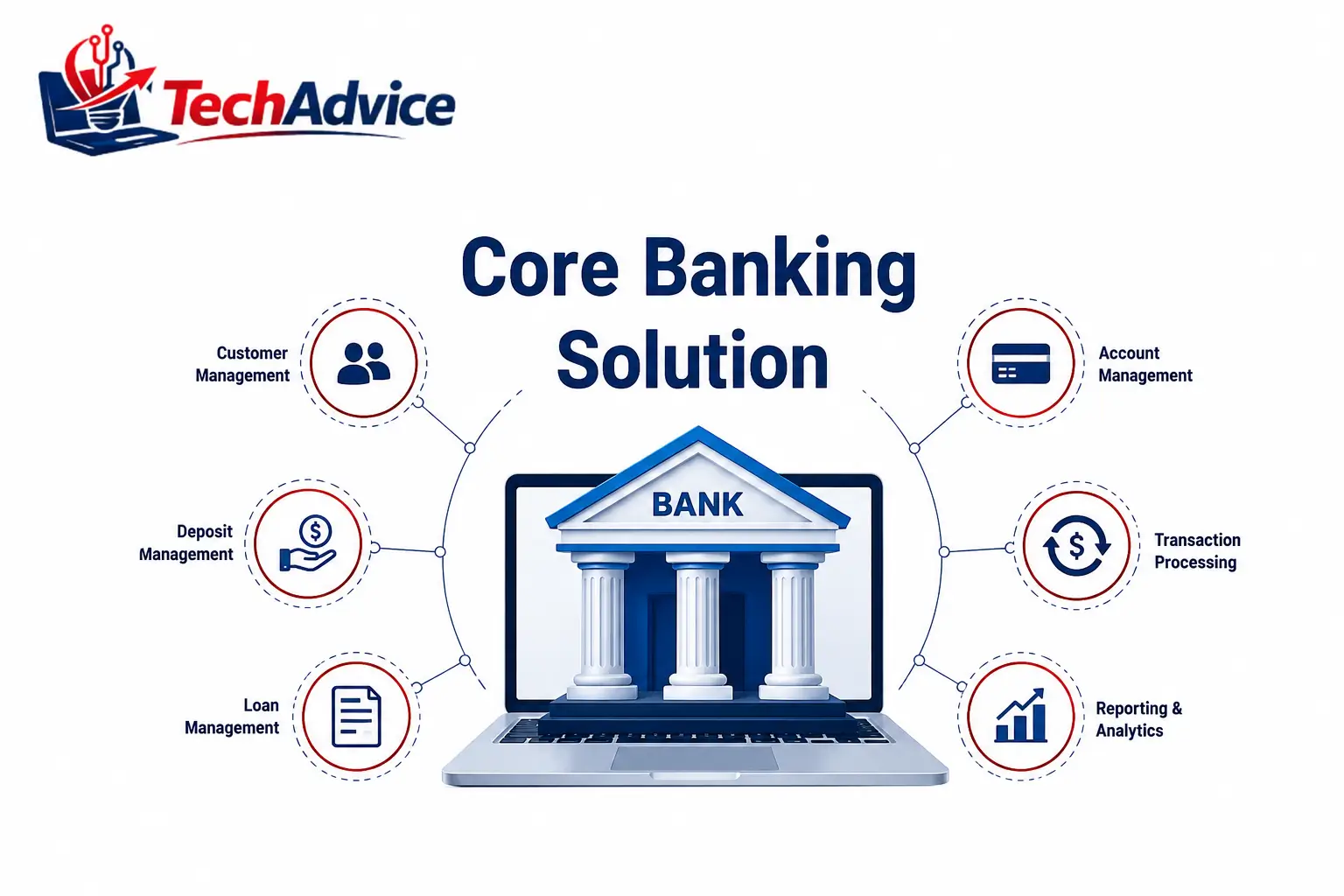
Modern banking looks simple from the outside. You open a mobile app, check your balance, transfer money, or withdraw cash from an ATM. Everything feels instant and easy.
But behind this simplicity is a powerful system working nonstop in the background. That system is called a core banking solution.
Without it, banks would not be able to offer real-time transactions, unified customer accounts, or seamless digital banking across branches and apps.
At Teche Advice – Daily Tech Updates, we break down complex software systems into simple, real-world explanations. In this guide, you will learn what a core banking solution is, how it works step-by-step, why it is important, and how it powers modern financial systems in the USA, UK, and Canada.
A core banking solution is a centralized banking software system that enables financial institutions to manage customer accounts, transactions, loans, deposits, and other financial services in real time across all banking channels, such as mobile apps, ATMs, and physical branches.
Instead of each branch working separately, everything is connected to one central system that updates data instantly.
This means when you make a transaction anywhere, your account updates everywhere at the same time.
- Core banking system powers modern digital banking
- It connects all branches and online platforms
- It processes transactions in real time
- It improves speed, security, and accuracy
- Banks depend on it for daily operations
Banking has changed completely in the last 20 years.
Earlier, if you deposited money in one branch, you often had to visit the same branch to access it. That system was slow, limited, and inconvenient.
A modern core banking solution solves this problem by centralizing everything.
Now customers can:
- Transfer money instantly
- Access accounts from anywhere
- Use mobile apps or ATMs globally
- Receive real-time updates
This shift is what made digital banking possible.
Without core banking systems, modern financial services would not exist in their current form.
To understand banking technology clearly, we need to see how the system works internally.
A core banking solution operates through a centralized database and a real-time processing engine.
A banking action starts when a user performs a task like:
- Sending money
- Withdrawing cash
- Checking balance
- Applying for a loan
This request can come from:
- Mobile app
- ATM
- Bank branch
- Online banking portal
Instead of processing locally, the request is sent to the central banking system.
This ensures all data is managed in one place.
The system checks:
- Account balance
- Identity authentication
- Transaction limits
- Security rules
This step prevents fraud and ensures accuracy.
Once verified, the system processes the transaction instantly.
Funds are deducted or added in real time.
This is where the core banking solution shows its real power.
After processing, the system updates all platforms:
- Mobile banking app
- ATM systems
- Branch records
Everything stays perfectly synchronized.
A banking system is not a single tool. It is made of multiple interconnected modules.
Handles customer accounts, balances, and profile details.
Processes deposits, withdrawals, and transfers in real time.
Manages:
- Loan approvals
- EMI schedules
- Interest calculations
Protects data using:
- Encryption
- Authentication
- Fraud detection
Generates:
- Financial reports
- Audit logs
- Compliance records
Let’s take a simple example.
A customer in California sends $1,000 to someone in Texas using a mobile banking app.
Without a core system:
- The transaction could take days
- Branch verification would be required
- Data might not sync properly
With a core banking solution:
- The transaction is verified instantly
- Money is transferred in seconds
- Both accounts update immediately
This real-time processing is what makes modern banking reliable.
A strong core banking solution provides several advantages.
Operations happen in real time without delays.
Users can access banking services anytime from anywhere.
Centralized systems reduce manual errors.
Modern encryption keeps financial data safe.
Banks can grow their systems without rebuilding everything.
| Component | Function |
| Central Database | Stores all customer data |
| Transaction Engine | Processes all banking actions |
| Security Layer | Protects data and prevents fraud |
| Integration Layer | Connects apps, ATMs, and branches |
| Reporting System | Generates financial insights |
This structure ensures smooth and reliable banking operations.
Even powerful systems have challenges.
Building a full banking system requires major investment in software and infrastructure.
Moving from old systems to modern platforms is difficult and time-consuming.
Regular updates are needed for:
- Security
- Performance
- Compliance
Modern digital banking in the USA, UK, and Canada depends heavily on centralized systems.
Banks now offer:
- Mobile banking apps
- Online payments
- Instant transfers
- AI-based financial tools
All of this runs on a core banking solution in the background.
Without it, digital banking would not function.
Banks need systems that are:
- Reliable
- Fast
- Secure
- Scalable
A core system provides all of these features in one platform.
That is why every major financial institution today relies on it.
Banking systems are evolving quickly.
Future improvements include:
- Cloud-native banking systems
- AI-powered fraud detection
- Blockchain integration
- Real-time analytics
These upgrades will make banking even faster and more intelligent.
Businesses also depend on banking systems for:
- Payments
- Payroll
- International transfers
- Financial reporting
A stable core banking solution ensures smooth financial operations for companies of all sizes.
Banks evaluate systems based on:
- Security level
- Performance speed
- Scalability
- Integration ability
- Cost efficiency
Choosing the right system is critical for long-term success.
If you want to understand more software and banking systems in simple language, explore more guides on Teche Advice – Daily Tech Updates. We simplify complex technology into practical, easy explanations anyone can understand.
A core banking solution is a centralized system that manages all banking operations like accounts, transactions, and loans in real time. It connects all banking channels into one unified platform.
It is important because it allows banks to process transactions instantly, improve customer experience, and maintain accurate financial records across all platforms.
It works by sending customer requests to a central system, verifying them, processing transactions in real time, and updating all banking channels instantly.
Yes. Mobile banking apps are directly connected to the core banking system, which ensures real-time updates and secure transactions.
Main benefits include faster transactions, improved accuracy, better security, and seamless access to banking services from anywhere.
The future includes AI automation, cloud banking systems, and blockchain-based financial infrastructure for faster and safer banking.